
Export Credit Insurance H1 2025: Volume Trends and Sectoral Shift
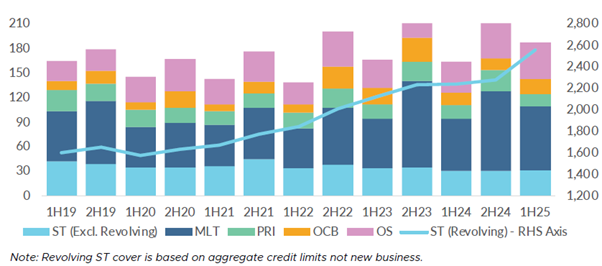
The current “Data Snapshot” from the Berne Union for the first half (H1) of 2025 records an increase in global new business to USD 2.74 trillion. The data reflects a shift in focus within medium- and long-term business toward renewable energies, as well as an increase in digital processes within the industry.
The results of the Berne Union[1] for the first half of 2025 reflect the current dynamics in world trade. With a total coverage volume of USD 2.74 trillion, the export credit and investment insurance industry continues to stabilize a significant portion of cross-border goods and capital transactions.
Short-Term Business: Growth Driven by Currency Effects
In the area of short-term (ST) cover, the volume rose to USD 2.6 trillion. This corresponds to a nominal increase of 12% compared to the previous half-year. However, the report points out that this increase was significantly influenced by the depreciation of the US dollar against other major currencies. In real terms, volumes remained at a stable level.
New Business by Business Line (USD bn.)
MLT Business: Renewable Energies as the Second Strongest Sector
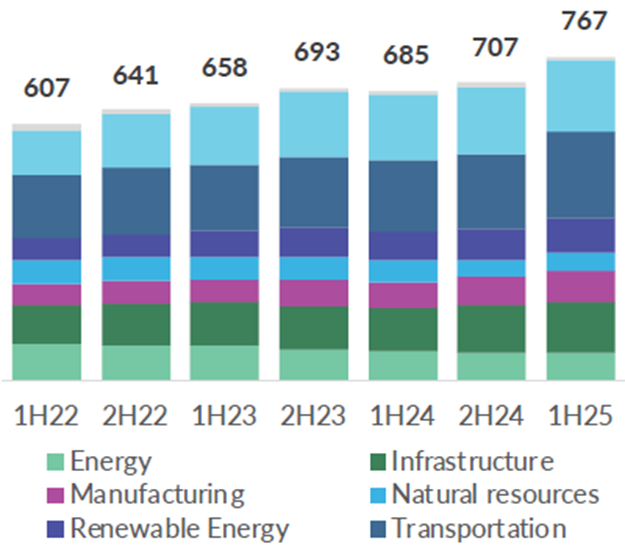
The medium- and long-term business (MLT) recorded a volume of USD 77.5 billion, the highest level for a first half-year since 2005.
- Sectoral distribution: The transport sector remains the leading segment due to large-scale infrastructure projects, particularly in the railway sector.
- Energy transition: New commitments in the renewable energy sector amounted to more than USD 10 billion. As a result, this sector has overtaken manufacturing and is now the second most important segment in the MLT business.
MLT Commitments by Sector (USD bn.)
Diversification and Digitalization
Insurers represented in the Berne Union are increasingly expanding their product offerings beyond traditional export business. Commitments for domestic support programs increased by 24% to USD 36.6 billion.
At the same time, the industry continues to advance its digital transformation. During the reporting period, 52 new digital applications were implemented, with a particular focus on process automation and customer portals.
Decline in Compensation Payments
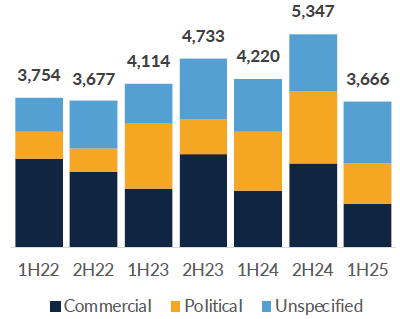
The claims side showed a downward trend. Compensation payments (Claims Paid) fell by 31% to USD 3.7 billion. This decline is primarily related to the stabilization of public finances in emerging markets. In contrast, however, there are rising risks and claim events in connection with geopolitical sanctions and events (e.g., Russia, Iran, Ethiopia, and some African countries).
Claims Paid by Risk Type (USD mn.)
You can download the full Berne Union report here.
Tailored Support through AIL Structured Finance
In export transactions, we stand by your side with our many years of experience and well-founded know-how to develop tailored solutions for financing your projects and hedging the associated risks.
Through our subsidiary Xport Finance AG (XFi), we also directly offer SERV-covered export financing. This enables exporters to offer their customers attractive financing packages as a competitive advantage and to safely manage complex risks.
[1] The Berne Union (www.berneunion.org) is the world’s leading association for the export credit and investment insurance industry. Its members include government-backed public export credit agencies, multilateral financial institutions, and private credit insurers from all over the world.